


In the modern industrial manufacturing environment, component traceability has become an essential requirement for ensuring quality and regulatory compliance. To implement this identification efficiently, companies must choose between static marking or an automated in-motion method, depending on the needs of each production line.
At COUTH, we specialize in designing advanced solutions that adapt with pinpoint precision to the speed and requirements of each industrial sector.
Choosing the right system affects the legibility of the marked code or characters and directly impacts plant productivity. Understanding how micro-percussion or laser technology interacts with parts in motion helps prevent unnecessary bottlenecks. Throughout this article, we provide an in-depth explanation of the technical differences, benefits, and ideal use cases for each of these marking methods.
What Is Static Marking and How Does It Work?
Static marking is the traditional method of industrial marking in which the part to be marked remains completely stationary during the process. The part to be marked is positioned in a fixed station or work cell, where it is secured using specific fixtures before receiving the impact or light beam. Once the part is completely stationary, the machine head moves to engrave the programmed information onto the surface.
For static marking systems to function correctly, precise synchronization between the arrival of the part and the activation of the cycle is essential. Operators or robotic arms place the part on the workbench; the system detects its presence and safely performs the marking. Upon completion of the marking process, the fixture releases the part to be marked, allowing it to continue on to the next stage of the production line.
Key Advantages of Static Marking
The greatest advantage of static marking is the absolute precision and uniform depth achieved thanks to the total immobility of the part being marked during the cycle. Since there are no vibrations or movements unrelated to the marking head, the geometry of DataMatrix codes, logos, or serial numbers yields excellent results that are easy to verify. This mechanical stability eliminates deformation errors in the marking, facilitating flawless subsequent readings by machine vision systems.
In addition, static marking systems stand out for their versatility in handling parts with complex geometries, irregular surfaces, or heavy weights that require controlled guidance. Since the operation takes place in a closed, controlled environment, initial integration costs are typically lower than those of high-speed automated lines. It is a robust, reliable, and very easy-to-maintain technology, ideal for production environments with moderate or variable volumes.
Common Industrial Applications
This type of technology is widely used for identifying robust components in the automotive sector, such as engine blocks or chassis. It is also the standard in metalworking shops and heavy machinery production lines, where parts are processed individually or in small batches.
In the aerospace sector, where each engraving requires precise depth control and thorough stress management, this method is preferred for its technical reliability.
What is dynamic marking and how does it work?
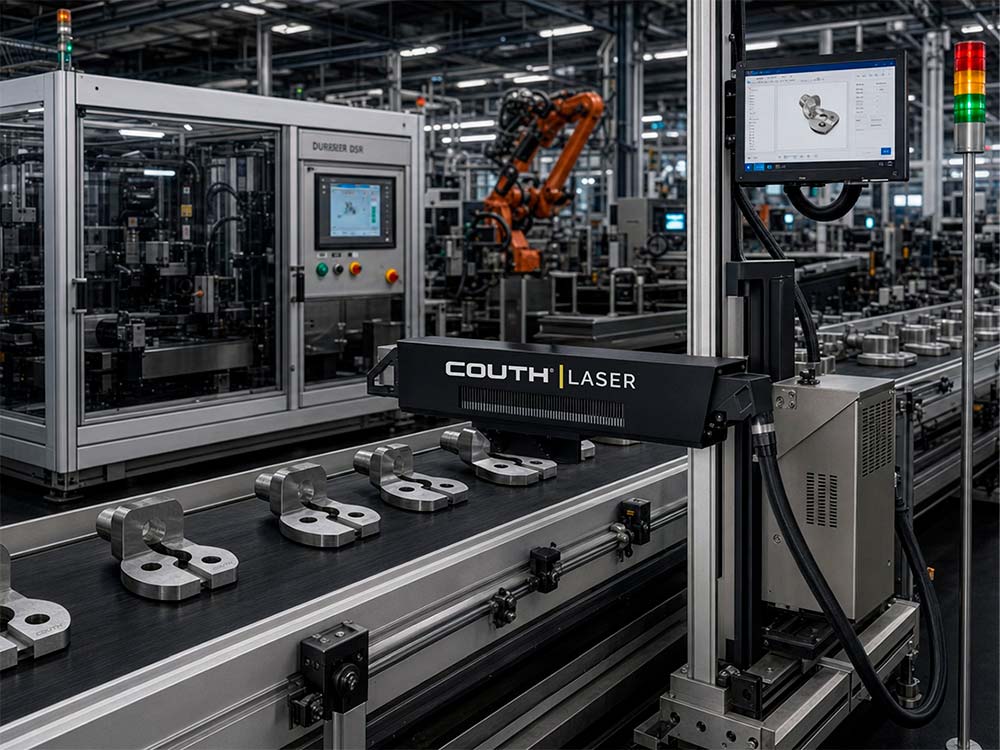
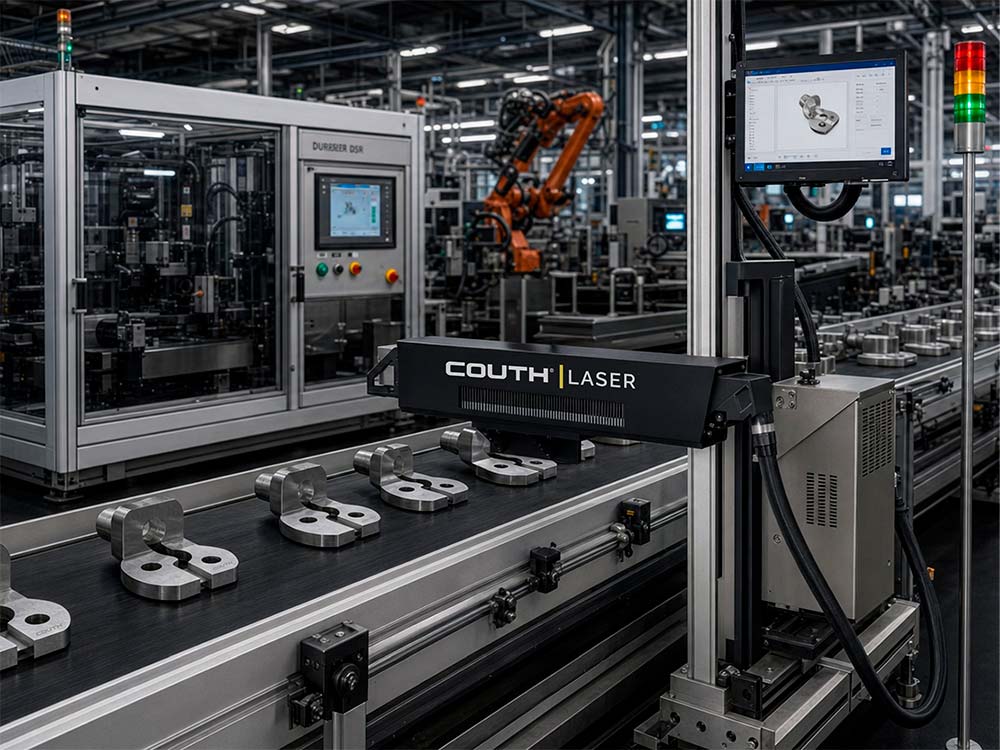
Dynamic marking represents the evolution toward full automation, allowing marks to be made on parts as they move continuously along the conveyor belt. In this mode, the part never stops, so the feed rate must be calculated to compensate for the movement. To achieve this successfully, rotary encoders and sensors are used to measure the exact pace of the production line in real time, without the need for physical contact with the part being marked.
This advanced concept is internationally known in the technical sector as Mark On The Fly (MOTF), a technology that is revolutionizing high-productivity manufacturing facilities. The equipment’s software processes the speed signal and instantly adjusts the laser marking or the movement of the lens in the laser head.
If you’re looking to optimize your factory with this level of automation, we recommend integrating a MOTF dynamic marking system designed to handle uninterrupted production rhythms.
Advantages of the In-Motion System
The major advantage of a dynamic marking system is the exponential increase in productivity, completely eliminating downtime and clamping delays. By integrating MOTF technology, marking becomes an invisible process that does not slow down the factory’s native speed. This translates into a lower cost per processed part and a total optimization of the resources available on the assembly line.
Another notable advantage of this system is the reduction in mechanical wear on clamping fixtures, since there is no need to physically handle the part. The most modern optical solutions, such as dynamic-focus (autofocus) laser marking, also allow the focal length to be adjusted on the fly if products vary slightly. This ensures crisp, permanent markings even on lines where products travel at extremely high speeds and with tight spacing.
As this is a ink- and solvent-free technology, the MOTF system eliminates reliance on printing consumables and simplifies the line’s operational management. Marking is also performed non-contact: the laser beam acts directly on the surface without exerting mechanical pressure on the package, leaving a permanent code engraved directly onto the material or coating, with high legibility that facilitates both automatic reading and subsequent quality control.
This technology is designed for integration into both new lines and existing facilities, operating dynamically on conveyors. Since there is no physical contact or ink consumables, maintenance is kept to a minimum, eliminating the need for cleaning, refilling, and consumable management tasks.
Finally, MOTF systems can be equipped with industrial communication protocols (PROFIBUS, PROFINET, EtherNet/IP) that enable their integration with automation and control systems, making this technology a solution ready for Industry 4.0 in 24/7 operating environments.
High-Demand Applications and Sectors
The Mark on the Fly methodology is deployed in high-volume, high-throughput industries where stopping the packaging line would halt the line’s profitability. At COUTH, this optical-mechanical technology is indispensable in sectors such as:
- Automotive and components: High-speed marking of VIN numbers, DataMatrix codes, and traceability data on engine blocks, brake system components, chassis, hubs, and custom metal hardware as they move through transfer lines or robotic cells.
- Steel and metal fabrication: Continuous coding of profiles, extruded tubes, steel coils, and billets. The material moves continuously through the rolling or cutting line while the equipment performs the marking without slowing down the workflow.
- Engineering plastics and capital goods: Direct identification on extrusion lines for high-density pipes, polymer components for the electrical industry, or heavy machinery, ensuring that regulations, measurements, and lot numbers are indelibly marked.
Direct Comparison: Which One Should You Choose for Your Plant?
To choose correctly between one method or the other, it is vital to analyze the daily production volume and the physical nature of the materials. If your factory processes large, heavy metal parts that require deep markings with perfect geometries, static marking is the optimal technical solution. This approach will provide you with the strength and positional control necessary to meet the most demanding quality standards in the industrial sector.
Conversely, if your goal is to maximize efficiency on a continuous assembly line, Mark On The Fly technology is the best choice. Whether you work with electronic components, aluminum profiles, or packaging, the dynamic system ensures that traceability does not slow down production. Process automation guarantees that every unit leaves the factory identified without adding a single second to the total cycle time.
The initial financial investment also differs, as static marking systems are simpler to configure and commission as standalone units. However, dynamic technology pays for itself very quickly thanks to time savings and the elimination of intermediate robotic handling steps. Analyzing the return on investment based on the seconds saved per component will give you the exact answer as to which system is best for you to install.
Technological Innovation with Dynamic Focus Laser Marking
Laser technology has taken a qualitative leap forward by introducing solutions capable of adjusting the focal length in real time according to the geometric requirements of each component.
Dynamic-focus laser marking incorporates a third motorized optical axis that coordinates with the galvanometer mirrors on the head. This dynamic Z-axis instantly adjusts the focal length of the beam on the moving part, eliminating the need to move the physical head or rely on external mechanical axes.
Thanks to this geometric adaptability, the system maintains the perfect focal point to clearly mark complex metal parts featuring uneven surfaces, sloped surfaces, spheres, cylinders, or 3D geometries.
This innovation brings tremendous flexibility to production lines in the industrial and automotive sectors. At COUTH, we develop these technologies to ensure that your company’s traceability is ready for the challenges of the smart industry.
Choose COUTH’s experience and reliability
Every factory is unique, with its own specific challenges regarding space, speed, materials, and international traceability regulations that must be strictly adhered to. Therefore, beyond choosing between static or dynamic marking, what truly matters is having a technology partner capable of advising you honestly.
We develop micro-percussion, engraving, and laser machinery designed to the highest durability standards to withstand demanding work shifts in industrial environments.
If you need to implement MOTF technology in your production lines, COUTH can help you. We analyze your product specifications and factory rhythms to design the perfect integration that guarantees complete legibility.
Contact us and discover how our industrial traceability solutions can boost your business’s efficiency, safety, and profitability today!
