


Applications · Types of Markings · DataMatrix

Industrial DataMatrix Marking for Permanent Part Traceability

Industrial DataMatrix marking allows parts, components, and products to be identified using a compact, machine-readable 2D code suitable for traceability systems. When applied directly to the part using permanent marking technologies, the code becomes an integral part of the component itself and can accompany it throughout its manufacturing, assembly, quality control, maintenance, and lifecycle.

In industrial applications, DataMatrix is used to encode information such as serial numbers, part numbers, lot numbers, manufacturing dates, production orders, or identifiers linked to databases. This capability makes it a particularly useful solution for companies that need to track individual parts, reduce identification errors, and connect the physical component to digital production or traceability systems.

COUTH develops industrial marking solutions using dot-peen, scribing, and laser technologies, which can be adapted to different permanent identification needs depending on the material, the part’s geometry, the required depth, the cycle time, and subsequent code reading.

line

What Is an Industrial DataMatrix Code

An industrial DataMatrix code is a two-dimensional code consisting of a matrix of light and dark cells that encode information in a small space. Unlike a linear barcode, the DataMatrix stores data in two dimensions, allowing more information to be included while occupying less space.

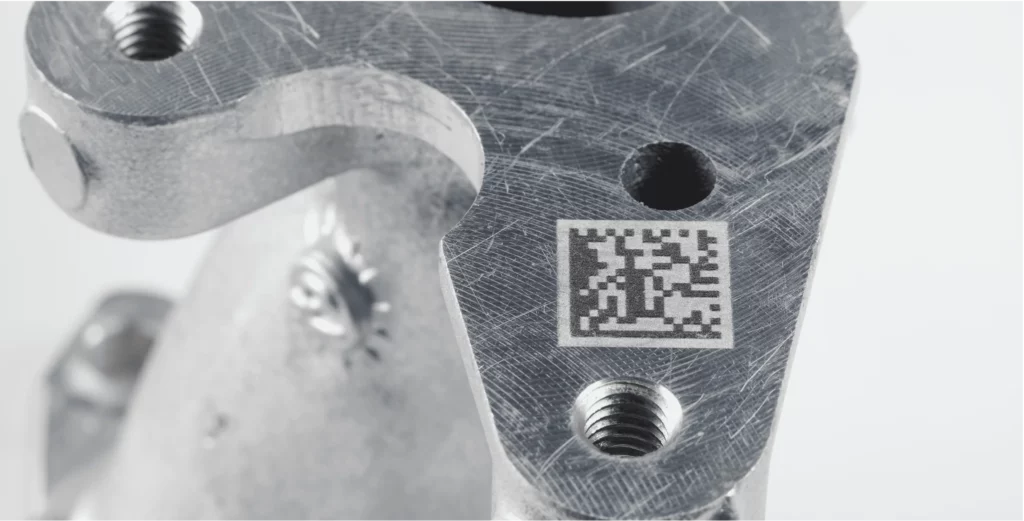
In industrial settings, the DataMatrix is frequently used as a direct part marking system, also known as DPM (Direct Part Marking). In these cases, the code is not printed on a label but is marked directly onto the material using a permanent technology such as dot-peen, laser, or, in certain applications, engraving.

An industrial DataMatrix code is a compact 2D code that identifies parts and components using encoded information. When marked directly onto the part, it facilitates permanent traceability, automatic reading, and individual tracking of each component in industrial processes.

line

What information can a DataMatrix contain?

An industrial DataMatrix can contain information such as:

In many applications, the DataMatrix does not contain all the product data, but rather a unique identifier that allows the complete information to be retrieved from a digital system. This configuration is particularly effective in advanced industrial traceability processes.

line

What Is DataMatrix Used For in Industry?

DataMatrix marking is used to identify parts, automate checks, and ensure traceability throughout the production process. Its primary function is to link each physical component to reliable and verifiable digital information.

Compatible Marking Technologies

DataMatrix marking can be performed using various permanent marking technologies. The choice depends on factors such as the material, the code size, the required depth, readability, the level of automation, and production environment conditions.

The three main technologies in COUTH’s field are:

line

Compatible Materials

DataMatrix marking can be applied to various industrial materials. The appropriate technology will depend on the material, the finish, the required depth, the expected durability, and production conditions.

line

Advantages of Industrial DataMatrix Marking

Identificación permanente

Permanent Identification

When marked directly on the part, the DataMatrix can remain legible throughout manufacturing, assembly, transportation, maintenance, and end use.

Mejora de la trazabilidad

Improved Traceability

The code allows each part to be linked to production, quality, batch, supplier, line, date, or process history data.

Alta capacidad de información

High Information Capacity in a Small Space

The DataMatrix allows information to be encoded on small surfaces, which is useful for small parts or limited marking areas.

Lectura automatizada

Automated Reading

It can be read using 2D scanners or machine vision systems, facilitating the automation of inspections and record-keeping.

Reducción de errores

Error Reduction

Automatic reading reduces transcription errors, part mix-ups, and manual identification failures.

Integración en procesos industriales

Integration into industrial processes

DataMatrix marking can be integrated into manual stations, robotic cells, machining lines, inspection systems, or automated processes.

Resistencia en entornos exigentes

Durability in demanding environments

With the right technology, the code can withstand handling, wear and tear, oils, greases, cleaning, temperature fluctuations, or subsequent processes.

Apoyo al cumplimiento de requisitos

Support for Traceability Requirements

In industries with internal, contractual, or regulatory requirements, DataMatrix facilitates individual identification and the recording of critical information.

Technical Considerations

Part Material

The material determines the response to marking, contrast, depth, legibility, and durability of the code.

Geometry

Flat surfaces facilitate marking and reading. For curved, irregular, or hard-to-reach parts, the available area, mounting, and orientation of the code must be analyzed.

Surface finish

Roughness, paint, anodizing, coatings, rust, or surface treatments can affect contrast and readability.

Required Depth

A part subject to wear or subsequent processes may require deeper marking. For precision parts, a shallower, more controlled mark may be preferable.

Code Size

The size of the DataMatrix code must be determined based on the amount of data, available space, marking resolution, and the reading system.

Production Speed

Cycle time influences the choice of technology. On high-speed lines, lasers can be particularly competitive, although dot-peen can also be effectively integrated depending on the application.

Reading System

The solution must be designed with consideration for how the code will be read: handheld scanner, fixed camera, machine vision, automatic verification, or reading at various stages of the process.

Environmental Conditions

Dust, oil, vibrations, variable lighting, humidity, or temperature can affect marking and reading. It is necessary to assess the actual working environment.

Integration

The marking system can be installed at a manual station, an automated cell, a production line, or a custom solution. Integration must consider communications, safety, tooling, and data validation.

line

Applications by Industry

Industrial Machinery

Machinery manufacturers can use DataMatrix to identify subassemblies, spare parts, nameplates, tooling, critical components, and items undergoing maintenance.

Energy, Gas, and Oil

DataMatrix can be applied to valves, flanges, connections, pipes, fittings, and metal components that require durable identification in demanding environments.

Electronics

In the electronics industry, it can be used to identify enclosures, connectors, heat sinks, metal plates, plastic components, or mounting elements.

Tools and Fixtures

DataMatrix marking enables the tracking of inventory, maintenance, calibration, service life, and assignment of industrial tools or fixtures.

Automotive

DataMatrix is used to identify engine parts, transmissions, chassis components, brake systems, machined parts, structural elements, and subassemblies. It enables the tracking of batches, processes, quality, and assembly.

Aeronautics

In the aeronautics industry, DataMatrix marking can be applied to machined components, structural elements, critical parts, and subassemblies that require documentation traceability and monitoring throughout their lifecycle.

Rail

In the rail industry, it enables the identification of metal components, spare parts, maintenance parts, structural elements, and mechanical systems subject to long service life cycles.

Metallurgy and Machining

In machining, casting, stamping, or metal fabrication processes, DataMatrix enables the identification of parts from early stages and maintains traceability during subsequent operations.

WE ARE SPECIALISTS IN INDUSTRIAL MARKING

What do you want to mark?

Contact COUTH to analyze your DataMatrix marking application and determine the most suitable solution based on the material, part geometry, required depth, reading system, and actual production conditions.

FAQS

Frequently Asked Questions About Industrial DataMatrix Marking

An industrial DataMatrix code is a compact 2D code used to identify parts, components, or products. It can contain serial numbers, lot numbers, part numbers, or identifiers linked to traceability systems.

It is used to identify each part individually, track its traceability, automate quality control, and reduce identification errors in industrial processes.

Yes. DataMatrix codes can be marked directly onto metals such as steel, stainless steel, aluminum, titanium, brass, or industrial alloys using micro-percussion, laser marking, or, in specific cases, engraving.

It depends on the application. Laser marking is generally suitable for small, high-definition codes. Micro-percussion is recommended for robust metal parts. Scribing can be used for deep markings or specific, validated applications.

Both are 2D codes, but DataMatrix is frequently used in industrial applications due to its compact size and suitability for direct part marking. QR codes are more common in general-purpose information access applications.

It can be permanent if performed using direct marking technologies such as micro-percussion, engraving, or laser marking. Durability depends on the material, depth, contrast, and conditions of use.

Yes. DataMatrix codes can be read using 2D scanners or machine vision systems. Reading reliability depends on the quality of the marking, lighting, contrast, and the reading system.

It can contain a serial number, lot number, part number, date of manufacture, production order, or unique identifier. In many cases, the code contains a key that links to an external database.

In demanding industrial applications, it is recommended to verify the code after marking to ensure that it is readable and that the data corresponds to the correct part.

Factors that influence readability include the material, contrast, depth, cell size, part geometry, lighting, surface finish, and the configuration of the reader or machine vision system.

Send us a message
Download our complete COUTH catalog