



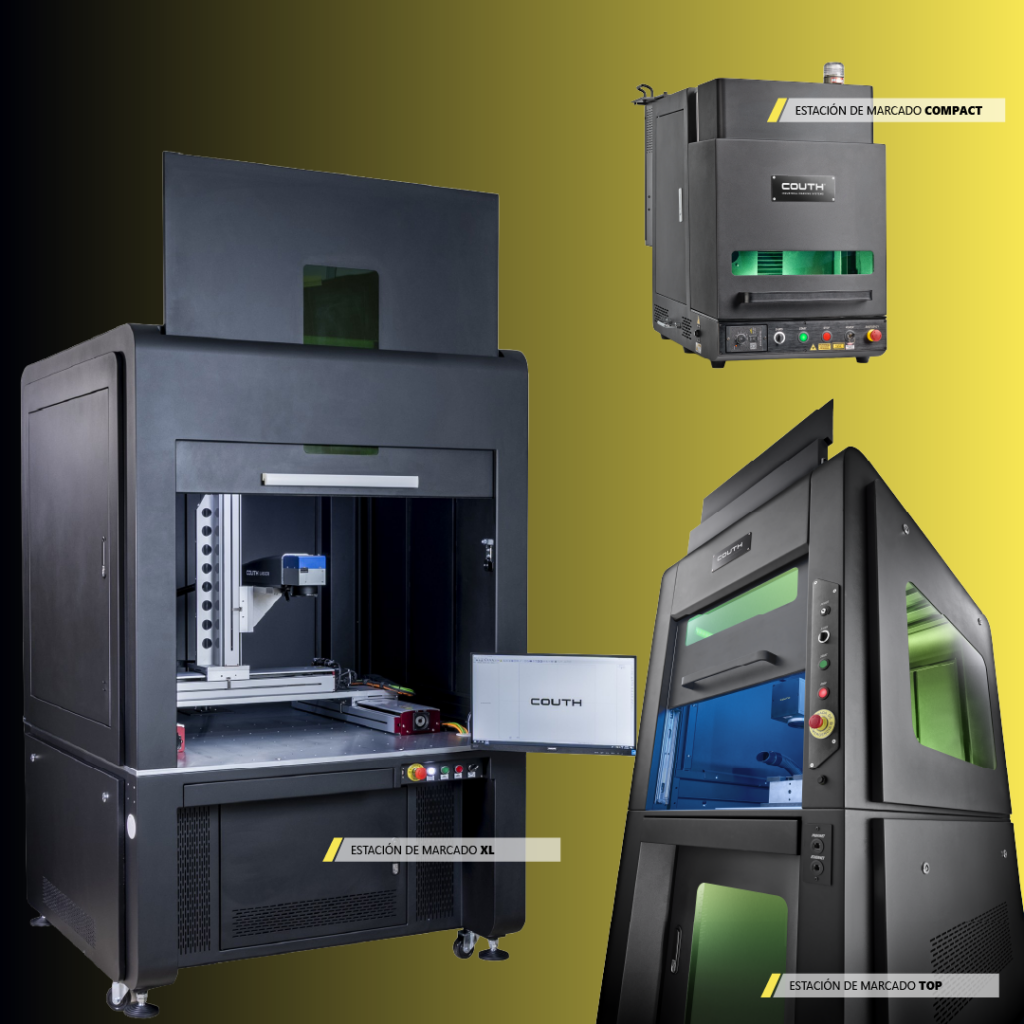

In industrial identification processes, marking quality does not depend solely on the laser technology used. Factors such as part positioning, process stability, the ergonomics of the marking station, and operator safety have a direct impact on the repeatability and reliability of the results.
For this reason, COUTH LASER® marking stations have been designed to integrate the laser marking system into a controlled and safe work environment, enabling improved traceability, optimized operations, and adaptation of the process to actual production needs.
Beyond the laser: controlling the entire marking process
In demanding industrial environments, marking must be:
- Precise and repeatable
- Safe for the operator
- Easy to integrate into production
- Adaptable to different parts and part numbers
Marking stations allow the process to be standardized through an environment designed to ensure stability, safety, and operational control.
This is particularly relevant in applications involving:
- Permanent traceability
- DataMatrix and QR codes
- Serialization
- Marking of logos, part numbers, or technical information
Safety, ergonomics, and stability in a single environment
One of the main objectives of a marking station is to create a safer and more efficient work environment.
COUTH stations include:
- Various models of Class I enclosed marking stations
- Manual or automatic opening systems
- Operator protection and safety signage
- Worktables designed for fixtures and part clamping
- Pre-installation for fume and dust extraction
This approach not only improves safety but also helps maintain the cleanliness of the optics and the stability of the marking during continuous production.
How to choose the right marking station
Each application requires a different approach. That is why COUTH offers various configurations adapted to different production environments.
COMPACT Marking Station

Designed for small parts and workstations with limited space, the COMPACT marking station allows you to transform laser marking into a safe and efficient cell without overcrowding the work environment.
It is particularly suitable for:
- Identification plates
- Machined components
- Small metal parts
- DMC/QR code marking and serialization
Its compact design and vertical opening enhance ergonomics and optimize available space.
TOP Marking Station

When the goal is to increase workstation productivity and process multiple parts per cycle, the TOP station offers greater capacity and automation-oriented options.
It allows:
- Marking multiple part numbers in a single process
- Working with multi-part fixtures
- Reducing loading and unloading times
Additionally, it incorporates a motorized column and programmable options for frequent part number changes.
XL Marking Station

The XL marking station is designed for more complex applications, where part size or the need to work in different positions dictate the process.
It integrates motorized travel in:
- XY axes of 600 x 600 mm
- Z axis of 600 mm
- W axis with angular rotation of up to 360°
This allows marking to be adapted to complex geometries, covering large areas without moving the part, and maintaining high precision in multi-position applications.
An environment designed for industrial traceability
Marking stations not only improve the operational process. They also allow traceability to be integrated directly into the production flow.
COUTH Laser solutions enable:
- Marking of 2D and GS1 codes
- Permanent traceability
- Technical identification and serialization
- Marking on metallic, plastic, and organic materials
All while maintaining a secure, repeatable environment ready for industrial integration.
Adapted to different production needs
From compact workstations to large-format applications, marking stations allow the process to be adapted to:
- Different part sizes
- Frequent part changes
- Automation requirements
- Specific traceability needs
The goal is not just to mark, but to do so in a more stable, safe, and efficient manner.
Marking stations represent an evolution in how laser marking is integrated into the industrial environment.
It’s not just about incorporating a laser, but about building a work environment designed to improve ergonomics, increase repeatability, and ensure process traceability.
Want to analyze your application?
At COUTH, we help you determine which marking station best suits your process, part type, and production needs.
