


The identification and traceability of industrial products require marking solutions capable of adapting to the characteristics of each material. However, not all materials respond in the same way to different marking technologies.
In the case of organic materials, such as wood, paper, cardboard, or leather, it is especially important to select a technology that produces legible and permanent marks without compromising the product’s properties.
Which marker is best suited for these applications? What factors should be considered before choosing a machine?
In this article, we examine the specific challenges of marking organic materials, the advantages of laser technology, and the factors you should consider when selecting the most appropriate solution.
1. What technologies are used to mark organic materials?
Organic materials have characteristics that determine the choice of marking technology. Their composition, texture, thickness, and sensitivity to temperature can directly influence the resulting mark.
Among COUTH’s industrial marking solutions, CO₂ laser technology is the option used for marking organic materials.
Unlike mechanical marking systems, which operate through direct contact with the surface, the laser allows marks to be created without applying pressure to the part.
The CO₂ laser uses a wavelength that interacts effectively with numerous organic materials, producing surface changes that enable the creation of text, codes, references, or logos.
Depending on the material and the parameters used, marking can be achieved through a color change, controlled carbonization, or a surface modification.
This adaptability makes the CO₂ laser a suitable solution for various industrial identification and traceability applications.
However, compatibility with a technology alone does not guarantee an optimal result. Each application must be analyzed taking into account the material and the characteristics of the required marking.
2. What organic materials can be marked?
CO₂ laser marking allows for work on various organic materials, although the result can vary considerably depending on their composition and finish.
Laser Marking on Wood
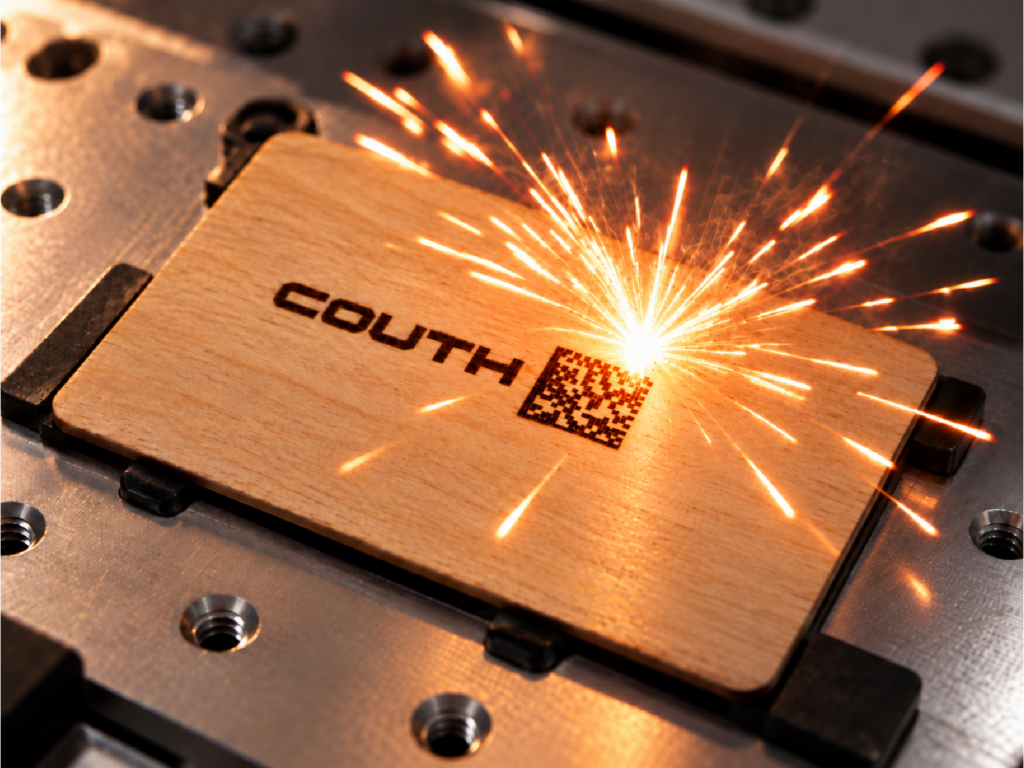
Wood is one of the organic materials that can be marked using CO₂ laser technology.
The process allows for the creation of text, references, codes, or logos through a controlled modification of the surface, typically accompanied by a darkening of the material.
However, factors such as density, moisture content, grain, or the presence of varnishes and surface treatments can affect the uniformity of the marking.
Therefore, it is important to adjust the operating parameters to achieve the necessary contrast and definition.
Laser Marking on Paper and Cardboard
Paper and cardboard are commonly used in packaging, shipping, and product identification applications.
On these materials, the CO₂ laser can be used to mark variable information, such as dates, lot numbers, part numbers, or identification codes.
Their main characteristic is their sensitivity to heat, especially in thin substrates.
For this reason, marking must be performed using appropriate parameters to achieve legible identification without causing perforations, deformation, or excessive deterioration of the material.
Laser Marking on Leather
Leather can also be marked using CO₂ laser technology, allowing for the incorporation of reference numbers, logos, and other identifying elements.
In this case, the surface finish, the leather’s treatment, and the marking depth are determining factors.
Proper configuration allows for control over the visual result and adaptation of the process to the characteristics of each piece.
Other organic materials
In addition to wood, paper, cardboard, and leather, there are other organic materials that may be compatible with CO₂ laser marking, such as certain natural textiles.
However, their composition and the treatments applied can alter their behavior.
Therefore, before selecting a marking machine, it is advisable to verify the feasibility of the process by testing on actual samples.
Discover COUTH’s solutions for marking organic materials
3. Why Choose a CO₂ Laser Marker for Organic Materials?
CO₂ laser technology offers several advantages for industrial identification applications on compatible organic materials.
Non-contact marking
One of its main features is that the process is performed without mechanical contact.
This prevents pressure from being exerted on the part and facilitates the marking of materials that may deform or deteriorate when subjected to mechanical stress.
Flexibility in marking content
CO₂ laser markers allow for the generation of various types of information, including:
- Text and references.
- Manufacturing and expiration dates.
- Lot and serial numbers.
- Barcodes and 2D codes.
- Logos and graphic elements.
This flexibility allows the content to be tailored to the identification and traceability needs of each application.
Marking Without Inks or Consumable Tools
The laser creates the mark through the interaction of the beam with the material, without the need for inks or marking tools that come into contact with the surface.
This reduces operations related to replenishing printing consumables and tool wear.
Integration into Industrial Processes
CO₂ laser marking systems can be integrated into various production environments.
Depending on the application’s characteristics, marking can be performed while the part is stationary or by integrating marking solutions onto moving products.
This latter option is particularly useful in packaging processes, where products must be identified without interrupting the production flow.
At COUTH, we develop CO₂ laser marking solutions tailored to the identification and integration needs of each industrial process.
4. What factors should you consider before choosing a marking system?
Although CO₂ laser technology is suitable for numerous organic materials, the selection of the equipment and its configuration must be based on the requirements of each application.
The material and its finish
The composition of the material directly influences its interaction with the laser.
Two parts made from the same type of material may yield different results if they have different finishes, colors, coatings, or surface treatments.
Therefore, it is not enough to identify the material in general terms: it is necessary to know the characteristics of the surface to be marked.
The type of information and the required result
Not all applications require the same type of marking.
An alphanumeric reference may require a different level of definition than a DataMatrix code intended for automatic reading.
It is important to define in advance the content, the size of the mark, the contrast, and the conditions under which it must be read.
Production speed and volume
The production rate determines the configuration of the marking system.
For single-unit applications or short runs, it may be appropriate to work with the part at a standstill.
However, in continuous production processes, it may be necessary to incorporate dynamic marking systems that allow products to be identified as they move along the line.
Part Geometry and Dimensions
The shape, size, and position of the surface to be marked also influence the choice of equipment.
It is necessary to consider the marking field, working distance, and integration options to ensure that the laser beam acts correctly on the required area.
Material Sensitivity
Organic materials may undergo changes in color, texture, or structure when exposed to thermal energy.
Therefore, the laser parameters must be adjusted to achieve the desired result and prevent unintended alterations.
It is also necessary to consider appropriate safety and exhaust measures for the byproducts generated during the process.
5. How can you verify that a marker is suitable for your material?
Before selecting an industrial marking solution, it is advisable to conduct tests on the actual material that will be used in production.
Even if a material is compatible with CO₂ laser technology, the final result depends on various variables, such as its composition, finish, thickness, and marking parameters.
Testing allows you to evaluate aspects such as:
- Contrast: verify that the mark stands out sufficiently from the surface.
- Legibility: verify that text, references, and codes can be correctly identified.
- Definition: analyze the precision of characters and graphic elements.
- Material integrity: verifying that the process does not cause alterations incompatible with the product’s requirements.
- Marking time: determining whether the solution can keep pace with the required production rate.
At COUTH, we study the characteristics of each application to determine the most appropriate technology and configuration.
Our technical team can analyze the material, conduct marking tests, and help you define a solution that meets your process’s identification and traceability requirements.
Do you need to mark an organic material?
Each material has different characteristics and requires an analysis of the marking conditions to achieve the desired result.
At COUTH, we help you find the most suitable marking solution for your application.
Contact us so we can offer you the best marking solution for your material.
