



Mark on the Fly, or in-motion laser marking, can be integrated into both existing production lines and new installations.
By performing marking without stopping the part, the MOTF application facilitates the incorporation of traceability within the production flow itself, preventing the identification operation from becoming a separate step in the process.
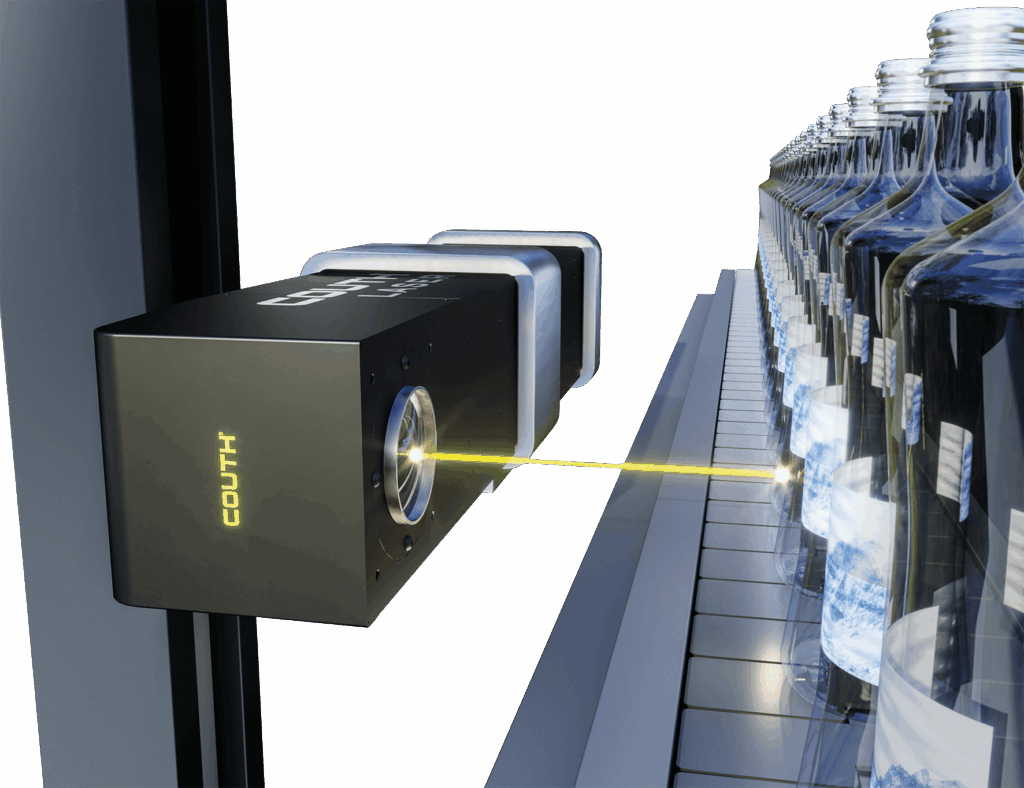
Marking of moving products, without the need to stop each part during the identification cycle.
Synchronization with line speed via encoders and detection systems.
Product displacement compensation to maintain the position and geometry of the mark.
Marking of fixed and variable information, such as codes, text, serial numbers, or logos, depending on the configuration.
Integration into conveyors and automated systems, adapting to different production architectures.
Compatibility with various COUTH LASER technologies, selecting the laser source according to the application.
Marking of moving products, without the need to stop each part during the identification cycle.
Synchronization with line speed via encoders and detection systems.
Product displacement compensation to maintain the position and geometry of the mark.
Marking of fixed and variable information, such as codes, text, serial numbers, or logos, depending on the configuration.
Integration into conveyors and automated systems, adapting to different production architectures.
Compatibility with various COUTH LASER technologies, selecting the laser source according to the application.

The product does not need to be specifically stopped for marking, reducing downtime associated with this operation.
Allows for the integration of identification and traceability within continuous, high-throughput processes.
The ability to work with variable codes and data allows each product to be identified as it moves along the line.
In the documented MOPA laser configuration, the process requires no inks, labels, or chemicals associated with marking.
Its integration with sensors, encoders, and control systems allows marking to be incorporated as just another step in the automated process.
It can adapt to different product formats and sizes and to changes between batches, provided the system is configured accordingly.
The product does not need to be specifically stopped for marking, reducing downtime associated with this operation.
Allows for the integration of identification and traceability within continuous, high-throughput processes.
The ability to work with variable codes and data allows each product to be identified as it moves along the line.
In the documented MOPA laser configuration, the process requires no inks, labels, or chemicals associated with marking.
Its integration with sensors, encoders, and control systems allows marking to be incorporated as just another step in the automated process.
It can adapt to different product formats and sizes and to changes between batches, provided the system is configured accordingly.
Mark on the Fly (MOTF) is a dynamic marking system that enables laser marking while the product is moving along a production line.
No. The main function of the MOTF system is to synchronize the marking with the product’s movement so that identification can be performed without the product having to stop.
The system can use encoders and sensors to determine the product’s speed and position and adapt the marking to its movement.
Depending on the configuration, text, part numbers, serial numbers, logos, DataMatrix codes, QR codes, and other data used for identification and traceability can be marked.
Yes. COUTH offers MOTF as a feature available in its Fiber, MOPA, and CO₂ solutions. The most suitable technology depends on the material and the specific process conditions.
Según tus respuestas, necesitamos un poco más de tiempo para darte una recomendación. Por favor, ponte en contacto con nosotros.