



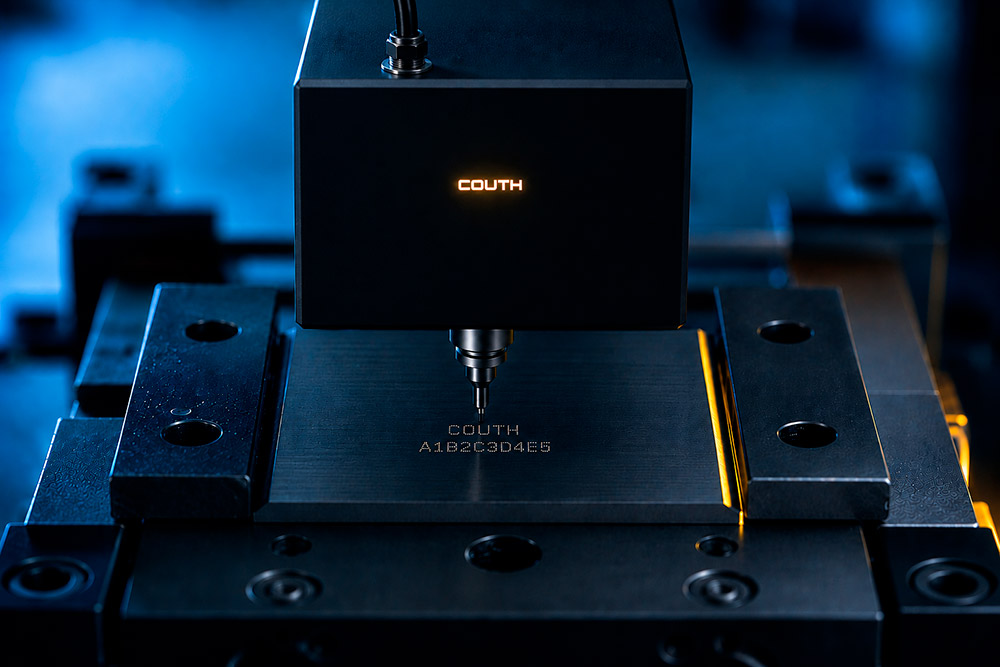
The serial number is the “ID” of any product, component, or piece of machinery, serving as the only reliable link to full traceability, warranty management, recall management, and protection against counterfeiting. Therefore, when a customer or an audit requires an accurate record of each batch, the operational question becomes a priority: How do you mark serial numbers, and what machine should you use to ensure they remain legible for their entire lifespan?
The answer is not one-size-fits-all. Attempting to apply the same marking technology to a hardened steel alloy, an injection-molded polymer housing, or a structural wood component is a critical mistake that can result in deformed parts, blurred characters, or unexpected machine downtime.
At COUTH, with a proven track record in designing industrial traceability solutions, we know that every production line requires a rigorous analysis of its substrates. That’s why, in this article, we provide practical guidance to help you identify the ideal marking machine for marking serial numbers with complete clarity, optimizing cycle times and eliminating extra costs in your manufacturing plant.
The Importance of Choosing the Right Marking Technology
For those responsible for ensuring quality standards, a defective serial number is equivalent to a part that doesn’t exist in the records.
The method chosen for marking serial numbers must withstand the environmental conditions to which the part will be exposed, whether mechanical friction, corrosive fluids, outdoor exposure, or subsequent heat treatments.
Therefore, the selection of equipment does not depend on the code design, but rather on the physical nature of the material. That said, below we break down the specific requirements of the most common substrates in manufacturing and the technological solutions we offer at COUTH.
How to Mark Serial Numbers on Metal
Metal is the most widely used material in heavy manufacturing, the automotive industry, aerospace, and capital goods. However, this category ranges from ductile aluminum to steels with high structural hardness. In these cases, the marking must penetrate the surface or permanently alter its molecular structure.
To mark serial numbers on metal, production facilities have three main technologies to choose from, depending on their requirements for speed, depth, and noise levels:
Micro-percussion Markers
This is the industrial solution par excellence for marking serial numbers on metal when physical depth is required at the lowest operating cost. The machine’s pneumatic or electromagnetic head oscillates a hard metal tip (tungsten carbide) at a high frequency, delivering micro-impacts to the surface.
As the head moves, the accumulation of these points forms serial numbers with extremely high durability. Since this is a cold-forming process, it does not remove material or generate chips.
This is the perfect technology if the parts will subsequently undergo thick layers of paint, shot blasting, or galvanizing treatments, as the physical relief survives these processes.
Scratch Marking Machines
It works similarly to micro-percussion, but instead of striking, the diamond or tungsten carbide tip is pressed into the metal and dragged continuously across its surface. The result is a serial number marked with a continuous, clean line of excellent aesthetic quality. Its greatest advantage on the production floor is that it is a completely silent process, ideal for marking hollow components or sheet metal that acts as a resonance chamber when struck.
Laser Markers
If your production facility requires extreme speed and integration into high-performance synchronized production lines, the fiber laser is unbeatable. It uses a concentrated beam of light that removes the surface metal through ablation (laser marking) or generates controlled dark oxidation without raising the surface (thermal annealing).
The latter is vital for the medical and food industries, as it allows serial numbers to be marked on metal with minimal alteration to the surface layer, preventing bacterial growth or premature corrosion.
How to Mark Serial Numbers on Plastic
Polymers, resins, and engineering plastics (such as ABS, polyamides, polycarbonates, or PVC) are used in industries ranging from electronics to automotive components. Unlike metal, plastic is sensitive to excessive heat and excessive mechanical pressure, which can crack or deform the part’s surface.
To successfully mark serial numbers on plastic, the process is as follows:
Automation of the alphanumeric sequence
The process begins in the control software of the COUTH marker. The plant manager programs the prefix, suffix, and sequential counter. The software automatically manages the alphanumeric sequence, updating the serial number digit by digit for the next part in real time, thereby eliminating any risk of human error.
Adjustment of frequency and wavelength
To prevent the plastic from burning or warping, the beam parameters are calibrated. With the fiber laser (for dark or engineering plastics such as ABS and polycarbonate) or the CO2 laser (for acrylics and clear polymers), the power and exact pulse are configured to interact optimally with the material’s pigments.
Permanent Marking Process
The light beam strikes the plastic surface without mechanical contact. Depending on the selected technology, the serial number is created through:
- Foaming: An internal color change caused by thermal alteration of the pigment, ideal for achieving high-contrast characters (light letters and numbers on a dark background or vice versa) with a finish that is completely smooth to the touch.
- Surface marking: A clean micro-vaporization process that etches the characters into the material.
In-line production validation
The process takes just milliseconds per part and is integrated on the fly (Mark on the Fly). The result is a crisp serial number, resistant to solvents and friction, ready to pass any quality control audit.
How to Mark Serial Numbers on Wood
Although it is a less common material on large-scale automated assembly lines, wood and its composite derivatives (MDF, plywood) are essential in the manufacture of logistics pallets, furniture, export packaging, and design components that require strict regulations regarding origin and forest traceability (such as FSC or PEFC certifications).
For marking serial numbers on wood, mechanical impact technologies are ruled out due to the material’s fibrous and irregular nature, which absorbs the impact and impairs legibility. The ideal solution is:
CO₂ laser markers
The CO2 laser operates at a wavelength of 10.6 micrometers, which is optimally absorbed by organic materials. When the beam is directed onto the wood, it generates controlled, superficial carbonization.
The result is a clean mark, dark brown or black in color, with excellent contrast against the material’s light background. This technology allows for the high-speed application of sequential serial numbers without applying pressure to boards or slats that might splinter, offering a clean, moisture-free process that is highly cost-effective in the long term since it requires no hot stamps or physical stencils.
Other Materials: Glass, Leather, and Advanced Composites
In modern production facilities, it is common to encounter complex materials that do not fit into traditional classifications:
- Glass and crystal: Used in packaging, lighting fixtures, or automotive components. For marking serial numbers on this substrate, the CO₂ laser is the ideal tool. It creates a controlled micro-fracture on the surface that produces a very defined matte and opaque finish, without compromising the structural strength of the glass.
- Rubber and elastomers: Found in industrial hoses, tires, and seals. Deep micro-punching or fiber lasers allow for permanent marking that withstands continuous flexing and contact with mineral oils.
Key Factors to Consider Before Implementing Your Marking Equipment
As a plant manager, you must consider the operational variables of your production flow before purchasing marking equipment:
Level of Automation and Integration
COUTH solutions are available in three functional architectures:
- Portable (for bulky or hard-to-move parts),
- Desktop (for standalone workstations)
- Integrated (designed to communicate directly with programmable logic controllers via industrial protocols such as Profinet or Ethernet/IP).
Data Management and Connectivity
State-of-the-art marking controllers allow you to automate alphanumeric sequences, generate automatic counters and work shifts, or connect directly to your company’s ERP or MES system to retrieve the exact number corresponding to each part in real time.
Ensure traceability in your plant with COUTH
Knowing exactly which machine to use for marking serial numbers is a strategic decision that directly impacts productivity rates, waste reduction, and compliance with international quality standards.
Choosing the wrong equipment shortens the service life of tools or produces poor-quality marks that make reading difficult in later stages of the logistics chain.
At COUTH, we provide marking solutions tailored to the realities of your factory. Protect your products’ quality standards and ensure indestructible identification from day one. Contact us now!