



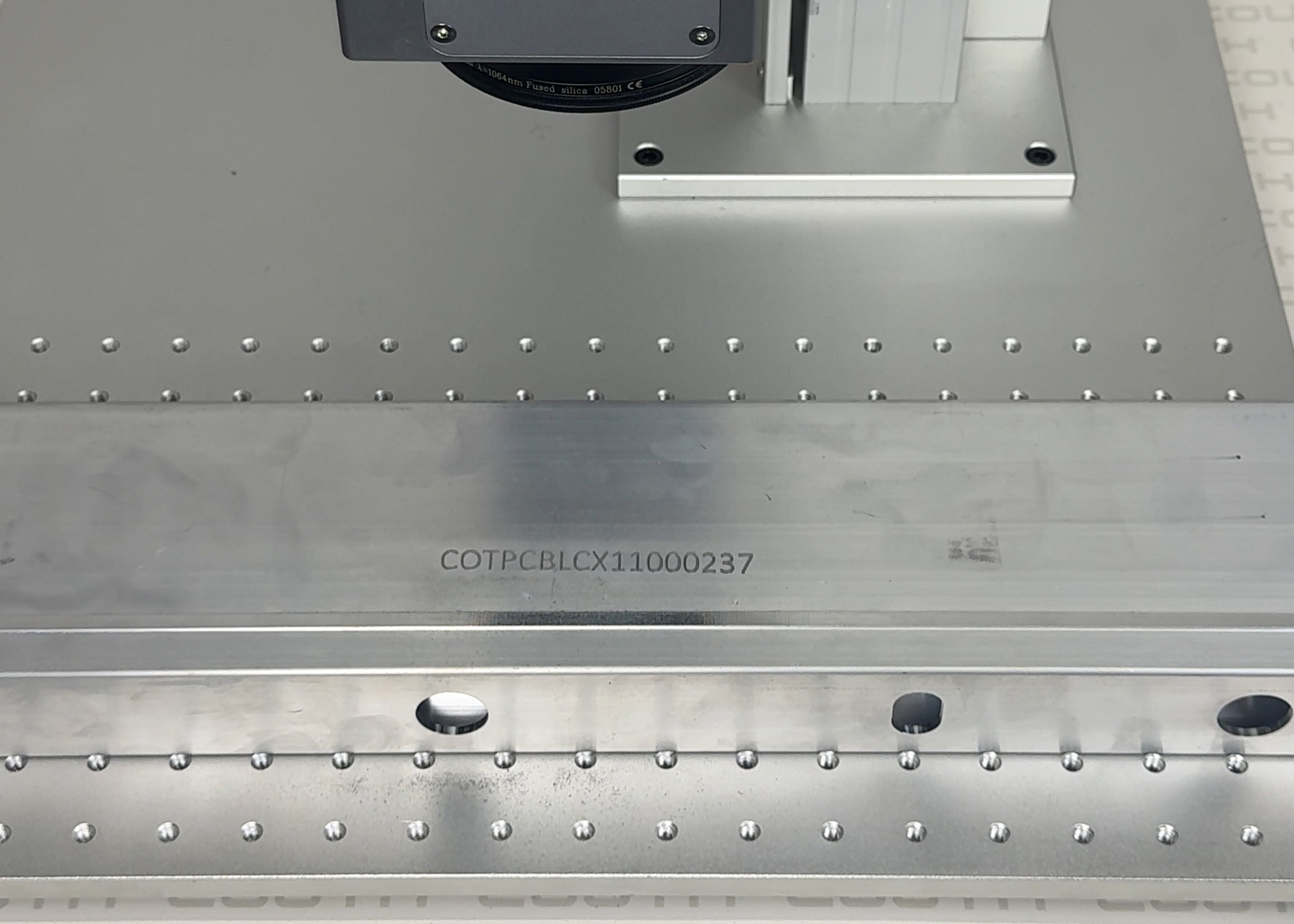
Industrial traceability is no longer an option. In Europe, permanent marking of products and components has become an essential requirement to comply with current legislation, guarantee consumer safety and ensure access to international markets.
In a context marked by the globalization of supply chains and new trade agreements — such as the recent free trade agreement between the European Union and India — requirements for identification, marking and traceability are becoming increasingly stringent.
In this scenario, technologies such as laser marking, dot peen marking or scribing play a key role for companies that manufacture, process or export products to the European and global markets.
Why is product marking mandatory in Europe?
The answer is clear: European legislation requires products to be identifiable, traceable and verifiable throughout their entire life cycle.
Traceability makes it possible to:
- Identify the origin of a product
- Track its path through the supply chain
- Act quickly in the event of incidents, recalls or quality issues
- Guarantee end-user safety
Without a reliable and permanent marking system, it is not possible to properly comply with these legal obligations.
European legislation and industrial marking: an increasingly demanding framework
Although there is no single regulation governing industrial marking, traceability is present in multiple European regulations and directives, including:
- EU Regulation on general product safety
- Product liability directives
- Sector-specific regulations (automotive, aeronautics, machinery, metallurgy, energy, etc.)
- Quality and certification requirements demanded by customers and regulatory bodies
In all cases, the common denominator is the same: the product must be clearly, legibly and permanently identifiable.
For this purpose, marking must be:
- Durable: resistant to wear, heat, friction or chemical agents
- Legible: for both humans and automated systems
- Inalterable: it must not be removable without damaging the product
- Unique: it must allow identification of each part or batch
This is where marking technologies such as laser, dot peen or scribing have become the reference solution.
Laser marking: the key technology for complying with European regulations
Laser marking is one of the most widely used technologies in industry to guarantee traceability and regulatory compliance.
Why is laser marking ideal for traceability?
- It is permanent and does not require consumables
- It offers high precision and legibility
- It allows marking on industrial materials
- It is compatible with DataMatrix codes, QR codes, text, serial numbers and logos
- It facilitates automation and integration into production lines
For these reasons, laser marking is widely used in sectors such as:
- Automotive
- Steel industry
- Aeronautics
- Railway industry
- Industrial machinery
Dot peen marking: durable impact marking technology
Dot peen marking systems allow deep marking on a wide variety of materials, including metals, plastics and composites.
What advantages does dot peen marking offer?
- Deep marking
- High-speed operation
- Easy handling
- Fixed or portable marking
Scribing marking solution: silent deep marking solution
What are the characteristics of a scribing system?
- Sound level 25% quieter than required by European regulations
- Clear marking at 0.5 mm on the surface
- Easy integration
Industrial traceability: beyond legal compliance
Although compliance with European legislation is a key factor, traceability provides many additional benefits for industrial companies.
A robust marking and traceability system allows companies to:
- Improve quality control
- Reduce errors and rework
- Facilitate audits and certifications
- Increase customer and partner confidence
- Protect the brand against counterfeiting
In an increasingly competitive market, traceability has also become a strategic advantage.
The impact of the new EU–India free trade agreement
The recent free trade agreement between the European Union and India opens up new opportunities but also reinforces regulatory requirements.
Many non-EU companies wishing to export to Europe will need to:
- Adapt their processes to European legislation
- Implement reliable traceability systems
- Ensure permanent marking compliant with European standards
This makes industrial marking for traceability a key requirement not only for European companies, but also for international manufacturers seeking access to the European market.
What does European legislation require in terms of traceability?
Generally, it requires that:
- The product or component is identified
- The marking remains legible throughout its entire service life
- The product can be linked to a batch, series or manufacturing process
- The information is reliable and verifiable
In many industrial sectors, this translates into the need for direct marking on the part, especially on metallic materials.
Marking on metals: challenges and solutions
Metal marking presents specific challenges:
- Hard surfaces
- Extreme operating conditions
- Exposure to heat, corrosion or friction
For this reason, solutions such as deep marking, laser marking, dot peen or scribing are essential to guarantee durable and compliant traceability.
Automation and traceability in production lines
In modern industrial environments, marking cannot be an isolated process. It must be integrated into the production line and company management systems to achieve not only legal compliance but also operational efficiency in high-speed lines and extreme conditions.
Current marking solutions allow:
- Integration with ERP and MES systems
- Automatic serialization
- Dynamic marking in production (mark on the fly)
- Error control
- Data recording for audits
How does COUTH help ensure compliance with European legislation?
At COUTH, we have been developing industrial marking solutions for years designed to meet the most demanding traceability and regulatory compliance requirements.
Our marking systems allow permanent marking on industrial materials, adapting to the needs of each sector and application. Likewise, our equipment integrates easily into production lines, achieving an efficient and automated process aligned with modern industry. All with a clear objective: to help companies comply with European legislation and ensure product traceability.
Conclusion: traceability as a pillar of the industrial future
In an increasingly demanding regulatory environment and with expanding international trade, industrial traceability has become a fundamental pillar of competitiveness.
Laser marking and permanent marking solutions are no longer just a technical matter, but a strategic tool to:
- Comply with European legislation
- Access new markets
- Guarantee quality and safety
- Strengthen brand trust
Investing in marking and traceability systems is investing in the future, compliance and competitiveness.